
Searching Clay County Civil Dockets
There is no anonymous countywide civil-docket form in Clay County. The remote public route runs through Mississippi Electronic Courts and its public arm. That arm is Public Access to MEC, known as PAMEC. That system is account-based and fee-bearing. It also splits Circuit and Chancery into separate endpoints, so a result in one says nothing about the other. For free electronic access, a public terminal is the practical alternative under the MEC access model. Look for one at a clerk's office or the courthouse during regular hours.
Gather the case type, the court, the case number, party or style, rough filing year, and the record you need. The clerk can then tell you what to order. That might be a docket printout, a filed document, a judgment, a certified copy, or a land-record instrument. Assume no specific filters beyond that, since no public search-field list or sample civil result is available without an account.
- Decide whether the matter belongs with Circuit Court, Chancery Court, or Justice Court.
- For eligible Circuit or Chancery records, use the official MEC/PAMEC route and the narrowest available identifier.
- For a clerk request, state the court, case type, year, known case number, and exact record requested.
- Ask whether a file is in local electronic access, paper, archive, or a restricted category.
- Confirm the amount, method, and timing before sending payment for any copy.
Clay County Civil Courts and Clerks
Circuit Court handles Clay County's Circuit civil litigation along with certain appeals from lower courts. Kim Brown Hood serves as the Clay County Circuit Clerk. Her office receives the lawsuits, motions, subpoenas, orders, and judgments that make up the Circuit record. Chancery work goes to Chancery Clerk LaFrance Hamilton Boyd. Her office covers equity, divorce, custody, adoption, probate, guardianship, land, title, and boundary matters.
Small civil claims can start in Justice Court. An appeal from there creates a Circuit Court record even though the dispute began below. So when you follow one matter, ask about the originating court and any appeal. The official Clay County Chancery Court page lays out the court's jurisdiction and district context.
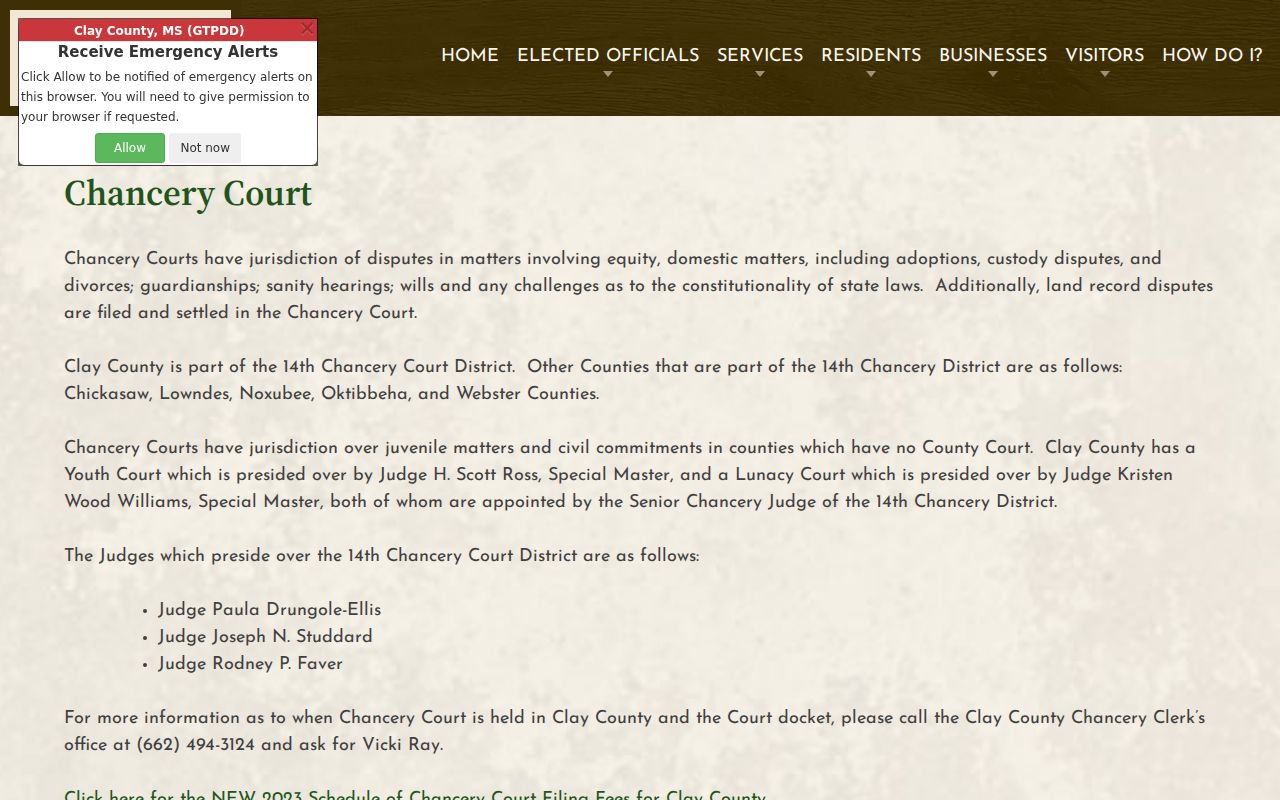
This is the division most people need for family, probate, equity, and land-related civil records in Clay County.
Inside a Clay County Civil Docket
A civil docket is a running register of events in a case. It can show a lot: the court, the parties, the filing date, a complaint or petition, an answer, motions, orders, settings, judgments, and an appeal. But a docket header is not the whole file. It may not display what a filing contains. It may not show the full text of an order, or a protected document.
| Case number | The court identifier. Clay research does not establish one public civil-number pattern. |
|---|---|
| Parties or style | The case caption, which should not be used to infer a result. |
| Filings and motions | Dated actions seeking relief or responding to a request. |
| Settings and orders | Hearing entries, court directives, and later rescheduling activity. |
| Judgment | A ruling that resolves some or all issues; request the order for its actual terms. |
The complaint or petition starts the matter. An answer or response gives the other side's position. A motion asks the court to rule, and a judgment resolves some or all issues. These labels tell you which document to request from the clerk, not what it says.
Clay County Civil Docket Access Routes
Remote access starts with Mississippi Electronic Courts and PAMEC. The Sixteenth Circuit MEC CourtInfo page covers the Clay Circuit endpoint. The Fourteenth Chancery district uses its own MEC route. PAMEC charges sit apart from clerk copy fees. Its terms include an annual charge for applicable users. Users also pay $0.20 per search-output page, charged even on a no-match page.
In person, bring Circuit civil records questions to the Circuit Clerk. Take Chancery, family, probate, and land matters to the Chancery Clerk. Call 662-494-3384 for the Circuit Clerk. Call 662-494-3124 for the Chancery Clerk to confirm the procedure. Chancery's published land-record instructions allow a mail request when you send book and page, payment, and a stamped self-addressed envelope. Fax and email contacts are published for procedure questions, but there is no universal electronic-delivery rule.
For a request under the Mississippi Public Records Act, pair the Act with the Mississippi Supreme Court public-records policy. Court records can also be controlled by court policy, statutes, rules, and confidentiality limits.
Civil Case Types on the Docket
Civil matters are divided by jurisdiction, not pooled into one Clay County docket. The Circuit Clerk's public role covers Circuit lawsuits and related filings. Chancery's official materials cover a broader equity and family group. Case type is a routing fact first. It is a label second.
| Court route | Examples documented locally | Record question |
|---|---|---|
| Circuit | Civil lawsuits and certain appeals | Ask the Circuit Clerk for the case file or docket. |
| Chancery | Divorce, custody, adoption, probate, guardianship, land, title, boundary | Ask the Chancery Clerk which records are public. |
| Justice | Small civil claims and lower-court proceedings | Ask Justice Court whether a later appeal exists. |
A Chancery fee category marked uncontested does not promise a fast divorce or adoption. It names the filing category, and court review or a hearing may still follow.
Clay County Civil Filing Fee Dates
Filing fees are not docket-copy fees. The Circuit Clerk's official fee page lists a civil filing fee of $161 along with other service charges. But no current general civil docket-copy charge is published. The February 2023 Chancery schedule commonly totals $148 or $158 depending on case type. Both schedules are dated, so confirm amounts with the clerk before payment. The Circuit Clerk fee page publishes the Circuit amounts.
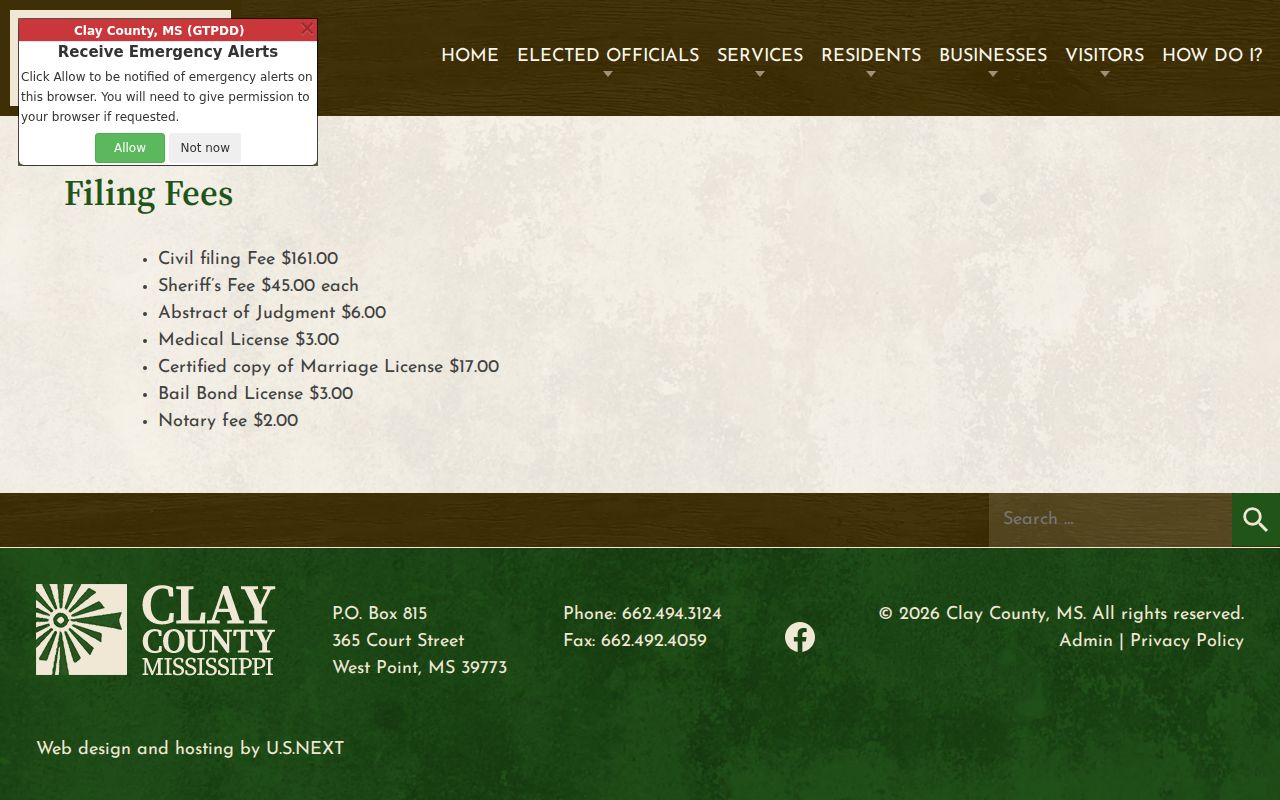
Treat the listed figures as dated filing information. They are not a promise of a current copy, certification, or service charge.
Civil Docket Settings and Hearings
A civil setting on the docket is a scheduled event, nothing more. It does not promise a final hearing. Clay County posts no single live calendar covering every court. There is no public filter by judge, courtroom, party, or event status. Before you count on any court date, confirm the court, the date, the time, and the event type with the clerk. Also ask whether a continuance has been entered. A dated PDF or a PAMEC entry can still help. Just check it against the clerk's records before you rely on it.
For a fuller route to the current date, see the county's Clay County court dates page. A scheduling change often shows up as a later docket entry, an order, or a clerk confirmation. It rarely appears as a swap into an old PDF. Treat the paper trail as the guide.
Clay County Civil Docket Records and Copies
Ask the clerk for the narrowest record that answers your question. A docket printout lists the case-history entries. A plain copy simply shows information. If another proceeding or agency requires proof, request a certified copy. When you know the date or number of an order or judgment, cite it. For an older Clay County file, give staff the approximate year, the originating court, the case number pattern, and the record type. Staff can then check paper, archive, or legacy storage.
Land records work differently. An index entry is not the deed, deed of trust, plat, or court order itself. The Chancery land-record instructions explain how to inspect records. They also cover requesting copies by book and page.
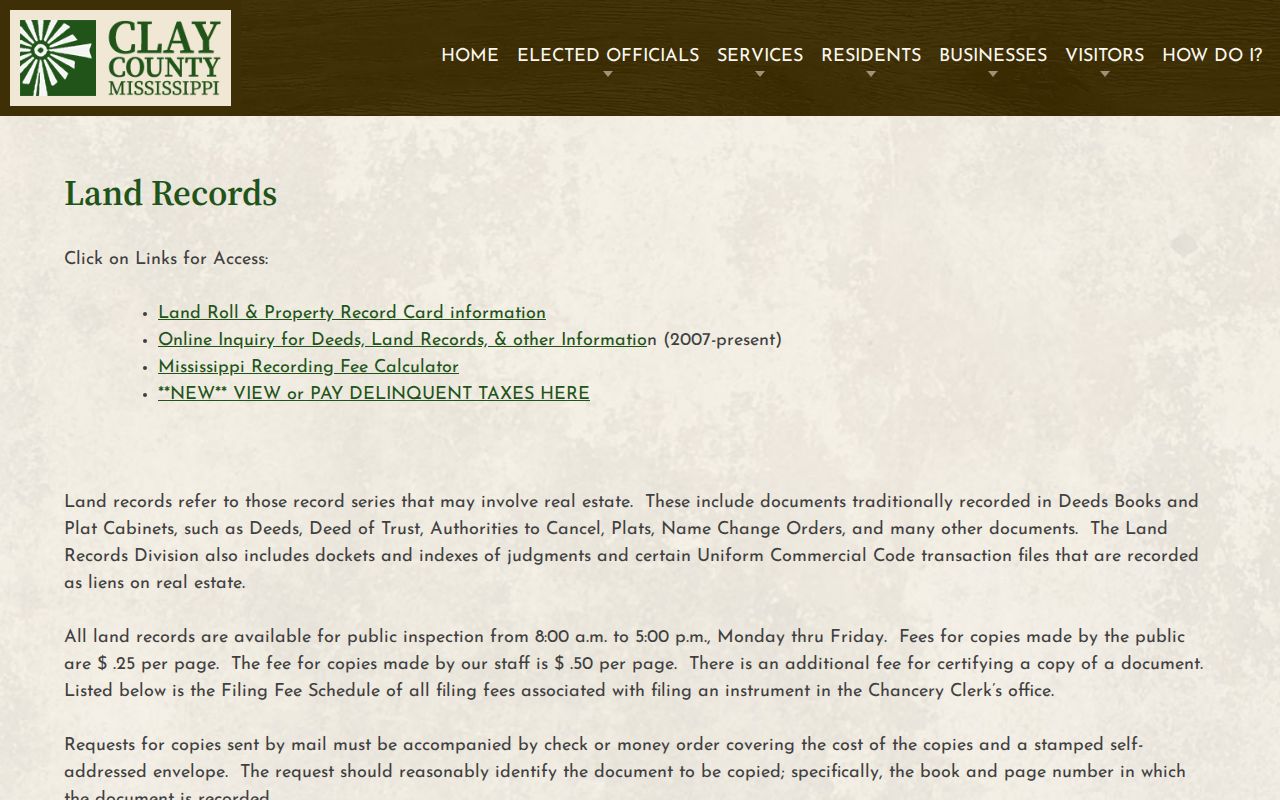
Keep land-index research separate from a court-docket request. Give the clerk the exact document identifier, and the copy you need.
Clay County Civil Docket Boundaries
Sealed, restricted, and archived files raise three different access problems. A restricted message usually means the filing is limited to authorized users. A sealed record is blocked by a court order. An archived or legacy file may still exist. But it takes clerk help to pull it. Family, youth-related, mental-health, and similar sensitive records carry their own access rules. Ask the clerk which ones apply.
- Sealed
- Public access is restricted by a court or rule; a missing document should not be reconstructed from a docket label.
- Restricted
- The system limits the viewer's access to a filing or case category.
- Archived
- The record may require a clerk search in older storage or a legacy system.
Note: A search result or docket header does not authorize publishing private family, financial, health, or child-related information.
Civil Docket Access Rules
The Mississippi Supreme Court public-records policy commits the judiciary to broad openness. It carves out exceptions. The Mississippi Public Records Act covers general access, response procedures, and fees. It cannot override court rules, confidentiality law, a sealing order, or the clerk's certification process. A specific request gets you further. It beats a demand for every case or document on file.
Request the record, not an assumption. The Mississippi Ethics Commission's Public Records Act page explains the Act's general framework.
Miss. Code Ann. §25-61-7 addresses public-record search and copy costs under the applicable policy.
Ask the clerk to identify the restriction, whether a redacted copy exists, the current fee, and the expected turnaround before sending payment.
Clay County Civil Docket Requests
Where you request records depends on which office keeps them. Circuit civil records sit with the Circuit Clerk. Chancery civil and family records sit with the Chancery Clerk. A lower-court civil matter belongs to Justice Court. A mailed request works best when it includes a return address, a phone or email contact, a case or book-and-page reference, and the exact copy you want. The office can then quote the current fee. It can also tell you whether a certified copy, an archive search, or a different clerk is required.
Mississippi's public-record framework sets general response procedures and allowable costs. It does not promise a court clerk will hand over a particular case file on a fixed timeline. Court policy, a sealing order, privacy law, and the work of locating an older file can all change the route. A clear request avoids a broad search charge. It also makes the clerk's answer easier to verify.